Key Takeaways
•The market: West Newton, MA real estate is expensive across the board. The median home value is $1,486,253, per DoorProfit's West Newton crime and safety profile.
•The question to test: A common question is whether Hill homes list higher for less space. Check that against recent sold homes before you assume it.
•The real choice: A smaller, older Hill house vs. a bigger house and yard elsewhere in West Newton or South Newton.
•The bottom line: Tour the Hill if walking to the village matters more to your family than square footage.
Do West Newton Hill Prices Outrun the Square Footage?
In West Newton, MA, the median home value is $1,486,253, according to DoorProfit's West Newton crime and safety profile.
West Newton Neighborhood Profile
A mixed-unit profile of West Newton’s population, housing occupancy, income, and home value.
Demographics
Population11,316
Median Age44
Housing
Owner-occupied68%
Renter-occupied32%
Income & Housing
Median Income$165,824
Median Home Value$1,486,253
The same profile shows a 68% owner-occupancy rate and a $165,824 median household income. That points to an established neighborhood where most owners live in their homes.
Many buyers ask whether the Hill charges more money for less house. That may be true for a given listing. However, public sources don't publish Hill-only prices, square footage or lot sizes, so treat it as a question rather than a fact.
Ask your agent to pull recent sold homes on and off the Hill. Then compare price per square foot, condition, lot size and location side by side.
What Are the Pros and Cons of Buying on West Newton Hill?
Pros
•You can walk toward the village center along Washington Street.
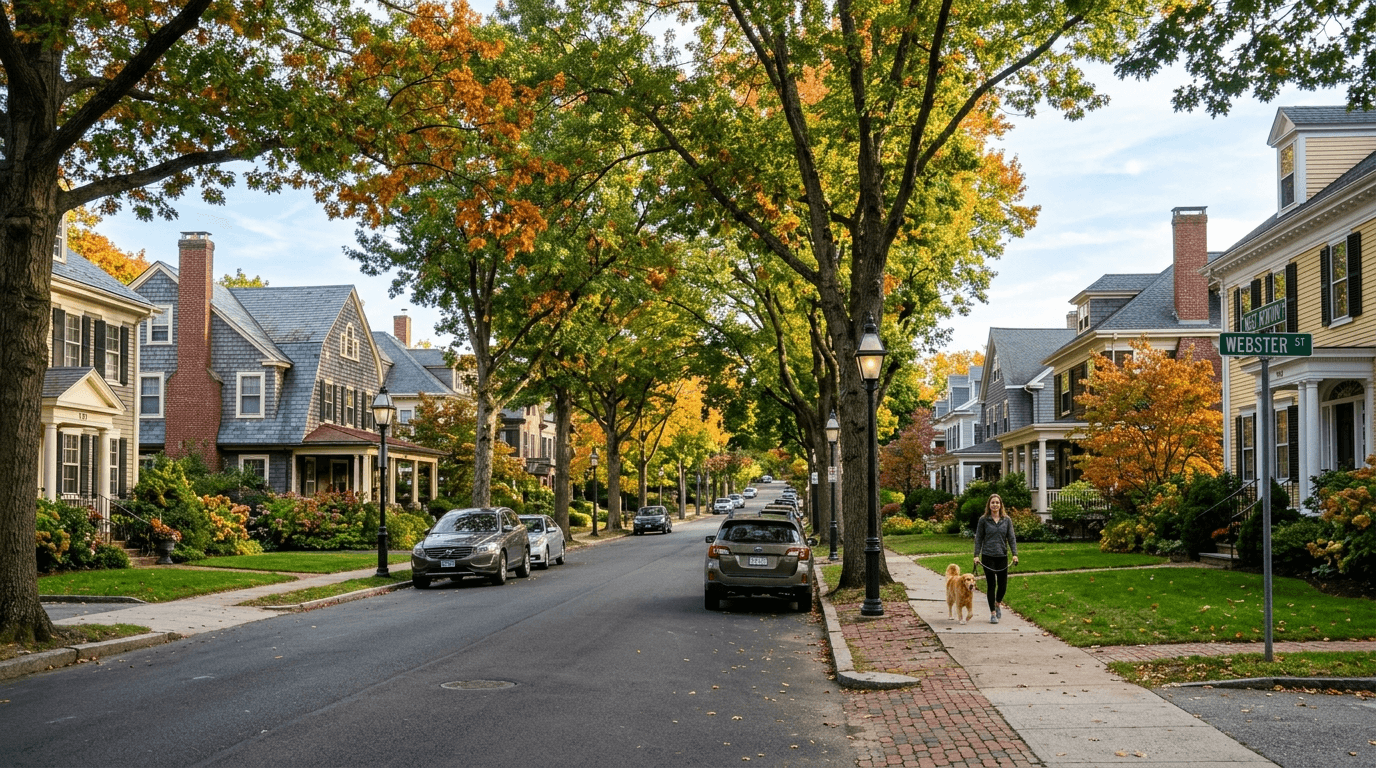
•Mature, tree-lined streets give homes strong curb appeal, meaning they look attractive from the street.
•The Hill name is familiar to local buyers. Ask your agent whether that has shown up in recent resale prices.
Cons
•You may get smaller rooms, older layouts and less yard.
•Heating, wiring, windows or roofs may need updates.
•Parking can be tight, and some homes lack a garage.
•Renovation plans may face extra review.
That last point matters for your budget. Demolition delay can pause the tearing down of an older building. Before you plan to expand or rebuild, ask your agent or the city's planning office whether demolition delay, historic district review or landmark review applies to the house.
Older homes are common both on the Hill and off it. The question isn't "Is old bad?" It's "Can I afford the updates this specific house needs?"
What Do You Gain by Buying Elsewhere in West Newton or South Newton?
Off the Hill, your money may stretch further. You may get more space, a larger yard, better parking or a layout that suits remote work. You may also avoid some old-house surprises.
The trade-off is lifestyle. You may drive more and lose the tree-lined, walk-to-village feel.
Walkability changes street by street, so test it yourself. Walk the actual route from the home to the village, commuter rail, coffee, parks or school at the time of day you'd normally go.
Zoning is another piece to watch. Newton's Village Center Overlay District has enabled 8 projects and 49 potential homes, according to the advocacy group Newton for Everyone, which describes the district as allowing more housing near village centers.
Newton Housing Pipeline: VCOD Projects and Potential Homes
Shows the reported number of Village Center Overlay District projects and the potential homes they could create, mostly within existing structures.
| Category | Housing Pipeline Count |
|---|---|
| Number of projects enabled by VCOD | 8 |
| Potential homes created | 49 |
Source:Newton for Everyone
If you're buying near any village center, ask your agent or the city's planning office what nearby lots may be allowed to build. That isn't a reason to avoid the area. It's a reason to understand nearby land use before you make an offer.
What Are the Strongest Arguments Against Paying the Hill Premium?
The case for a Hill premium rests mostly on anecdotes, not measured sales data. That evidence includes resident comments online and the neighborhood's reputation. The objection is fair.
No public data separates how much of any premium comes from prestige and how much comes from size, condition, lot or exact location. South Newton may well offer more space for similar money. Sold-home comparisons are the way to check.
So the premium makes sense only if you'll use the walkability every day. Don't pay more just because a home is "on the Hill."
The second objection is lot size. Lot-size figures you may see quoted often come from other parts of Newton, such as a zoning case in another district or a Newton Centre listing. Don't rely on them. Check each property in the city assessor database.
Who Should Choose West Newton Hill?
Choose the Hill if your daily life centers on walking, village access and older streets.
Choose elsewhere in West Newton or South Newton if you need more rooms, a bigger yard, easier parking or fewer renovation projects.
Before you make an offer on a Hill home, check:
1. Price per square foot against recent nearby sales
2. Age of the heating, wiring, roof and windows
3. Parking, garage and yard limits
4. Whether demolition delay or historic review affects your plans
5. What nearby lots may be allowed to build
6. The expected tax bill
For the tax bill, confirm the current residential tax rate with the Newton Assessing Department. Also ask how the home's assessed value, the value the city sets for tax purposes, compares with your price.
On West Newton Hill, you may be paying more for the location around the house than for the house itself. Before you bid, ask for a side-by-side sold-home comparison. It's the clearest way to see whether the premium is worth it for your family.